“I believe that’s what the entire world wants,” he says. “Whether it’s a Swiss watch or a British car or Italian clothes, they want quality and they want to know a lot of work and a lot of skill has gone into its manufacture, and they want to know that nobody has been hurt making it.” – Bruno Cucinelli
Author: bymorganmay.com
-
How the return of traditional skills is boosting Italy’s economy | World news | The Guardian
Artisan revival proves a boon for sluggish economy that has unemployment rate of 12%
There aren’t any smartphones distracting the budding couturiers at the tailoring school run by Brioni, the venerable menswear company, in Penne, a medieval town nestled in the heart of Italy’s mountainous Abruzzo region.
Instead, their nimble fingers are delicately sewing stitches on to jacket sleeves. They are nurturing the skills that could lead to a job in a fashion house whose sleek suits have been worn by kings, presidents and 007s Pierce Brosnan and Daniel Craig in their roles as James Bond.
The teenagers are the lucky group of 16 to have made the cut for the latest four-year programme at Brioni’s Scuola Di Alta Sartoria (High School of Tailoring), which in recent years has seen an uptick in applications from young Italians keen to learn the trade.
They are among a generation in Italy who are turning to industries that formed the backbone of the country’s post-world war two economy, with some skipping university in the process, amid a lacklustre job market.
“They join aged 13 or 14,” said Emidio Fonticoli, the school’s coordinator. “It’s important that they start young, due to the sensitivity of their hands and fingers. It’s an important time for them to develop manual skills, so much so they reach such a level of tactility, they can work without looking.”
But it’s not all blazers, belt loops and buttonholes: the aspiring tailors study maths, English and history as part of a combined school curriculum also aimed at readying them for the world of work in case they decide not to pursue tailoring.
Upon completion, the best are selected to work in the local factory, or in one of the company’s boutiques around the world. The most passionate ones succeed.

“The artisanal tradition is a cultural legacy that takes decades to transmit from a seasoned master to a young talent and despite common thoughts, a large number of young people continue to express their desire and will to learn the secrets of those crafts,” added Fonticoli.
Concerned about its ageing needle workers, Brioni opened the tailoring school in 1985 to ensure their skills were passed on. But it is not the only firm helping to revive the image of the traditional artisan, thus piquing the interest of young Italians.
“Working with your hands is becoming interesting,” Stefano Micelli, a professor at Venice’s Ca’ Foscari university and author of the book Future Craftsman, said, pointing to the allure of the “Made in Italy” brand and advertising campaigns by the likes of the fashion house Pucci and Brunello Cucinelli, famous for its cashmere jumpers, promoting a fresh image of the artisan.
“This [the advertising campaign] made a very important impact on a new generation who are thinking about craftsmanship in a different way.”
The revival has also filtered down to small businesses, with Italians rediscovering their entrepreneurial spirit, whether it be in shoe-making, hairdressing, tailoring or making pasta.
“This is a very Italian thing, we do have this long tradition in the small business area, it’s part of our culture,” added Micelli.
New technology and a push by regional and local level governments to help facilitate the growth of startups, particularly in the business hub of Milan, are also playing their part.
“The policies that are relevant to this new way of doing business don’t necessarily belong to the state government, but rather the local and regional municipalities,” said Micelli. “But I would stress that it’s not about being nostalgic and going back to the past, it’s about the future, technology, and being innovative.”
Driven both by curiosity and the need to find a job in a country where youth unemployment has almost doubled to 37.9% within the last 10 years, Federico Badia is an example of someone who set out to learn the secrets of his craft – but without the help of an esteemed school.
The 29-year-old shoemaker, who owns a shop in Orvieto, a hilltop town in Umbria, didn’t go to university and instead travelled across Italy in his early 20s looking for an apprenticeship.
He developed a passion for the craft while working for a cobbler in his teens, after stumbling across a pair of shoes that a customer had left for repair 38 years before.
The shop closed after the cobbler retired, and so he set out on a journey that took him to Turin, Florence and Milan in search of a master. Earning his keep by waiting on tables, he was rejected by all until he walked into a shoemaker’s shop in Rome and offered to work for free in exchange for being taught.
“By the time I got to Rome, I realised that I didn’t need a job, I needed to learn,” he said. “I worked for free for almost two years. Spending money on going to a school or university is easy but if you’re really passionate, you will find a way.”
Italy has one of the most sluggish economies in the European Union, with the overall unemployment rate standing at 11.7% in January, figures from Istat, the national statistics agency, showed.
But there are some signs of recovery among small artisanal businesses, with hiring among them rising 2.3% in 2016, according to data from CNA, the national confederation of artisans and small businesses.
Claudio Giovine, a chief economist at CNA, said this is partly due to the economy in general performing mildly better and firms having more flexibility with work contracts.
There has been a trend among school leavers veering towards traditional trades, but also among graduates striking out alone, he added.
“They are starting to rediscover the sartorial value in products, providing something custom-made, as well as the importance of Italy, which is at the forefront of things that are well made.”
Badia, who now sells shoes from upwards of €1,000, learnt from his shoe master that the most important requirement of an artisan was to be humble, which is also part of the Brioni tailoring school philosophy.
“Then, if you become a great artisan, it doesn’t matter where the shop is, if you’re humble and make a good product, the customers will come.”
Source: How the return of traditional skills is boosting Italy’s economy | World news | The Guardian
-
François-Henri Pinault on a More Sustainable Fashion Industry – Bloomberg
It’s a matter of being a part of the society where you want to do business, or not
Source: François-Henri Pinault on a More Sustainable Fashion Industry – Bloomberg
As you slip into heels or a tux to toast the New Year, you probably won’t be thinking about the fact that the leather in your shoes polluted drinking water in Indian villages, or that merino sheep were made miserable for your suit—and François-Henri Pinault doesn’t want you to have to. This year, the 54-year-old Frenchman is toasting the results in his 2016 sustainability report. The fashion industry pollutes heavily and relies on subsistence-wage earners and poorly treated animals. So the chief executive of Kering, which owns 16 brands, including Yves Saint Laurent, Gucci, Boucheron, and Puma, in 2012 set a series of goals to be met in four years that address every damaging aspect of the supply chain.
Kering hasn’t hit them all—the word “challenges” appears 34 times in the report—but its companies are using more recycled paper in packaging, improving working conditions, and eliminating some toxic chemicals, among other accomplishments. The $13 billion giant may represent only a small slice of the multitrillion-dollar apparel and accessories industries. But think of it as proof of concept, says Pinault, whose company’s stock has doubled in the four years since he’s implemented his plan.
Why did you set out to make Kering sustainable?
The [2013] acquisition of Puma was a game-changer. At that time, Puma was run by Jochen Zeitz. Jochen is someone who was personally committed to the environment. He went very far with it through Puma. And he gave me this new approach of sustainability. If you do it right, you can create for yourself amazing opportunity creating good for the planet, for your employees, for your shareholders, for stakeholders. It’s a completely different vision.We spent three years putting in place this EP&L [environmental profit and loss, a model that factors in environmental costs] methodology that is very complex. We did that with international partners, NGOs, and we invested a lot of money in that. This is available for everyone on a completely free basis. [Kering also developed an app called MY EP&L that allows designers to calculate the impact of any product using a criteria of 5,000 factors.] You need to make sure that the company is organized to deal with that commitment. And one of the first moves we did, it was in 2008, if I remember well, I created a sustainability committee at the board level. We were the first listed company in France to do that. For all my CEOs, part of their yearly bonus is linked to sustainability achievements. Everyone has to have a full-time position in charge of sustainability.
Is there a philosophical or spiritual component to your decision to run this kind of business?
I succeeded my father. I always heard him telling me that whatever the size, a company needs to pursue a cause that is beyond the profit target you usually have. It’s a matter of being a part of the society where you want to do business, or not. I’m here for a certain number of years, and I hope I will transmit [Kering] to someone else, be it my son or anyone. The question is, What am I going to build in the meantime? My father built something extraordinary; I want to leave something that is. I strongly believe this will be, I hope, my legacy.You say sustainability is now part of luxury. Isn’t luxury about excess?
Desires are short-term; we’re all about dreams. Fast fashion is about desire. Luxury is about dreams, so it’s all the time. You cannot make people dream if you’re cheating by offering a product that is a nightmare behind the scenes.Do you ever go personally to look at these efforts, such as the python skins used at Gucci?
Gucci is one of the biggest brands using python skins. It’s not an endangered species, but if we don’t change anything, this will become an endangered species, because there is no transparency in that trade. You cannot just say, “Well, I’m compliant with the certificate that you need,” because we all know that most of the certificates are not really … . We decided with Gucci to go much beyond that. And the only solution in that case is to integrate ourselves into the farming of python. So we are now investing in Thailand and in China in python farms.What’s it like?
Special. The python is an animal that needs to eat living animals. So you have to raise rats on the side. It’s also about making sure [we’re] respectful of the communities around the farm—we buy pythons from them. We use the [flesh] of the pythons, it’s used in those areas.We did that in crocodile farms also. It’s about the only way to really completely control the supply chain.
Was it hard to get your individual brands on board with the mission?
Not that difficult. But you have to understand that in a luxury brand, you have the creative people and the rest of the company. There’s always this thinking of, We have to let them do whatever they want. They cannot have rules or constraints around them, so don’t bother them with sustainability things, it will be a disaster.The first thing I did in 2008 was to see all the designers on a one-to-one basis. I said, “This is the commitment I’m thinking about. Where are you on that?” And it was amazing to see that they were even beyond me. I remember [Bottega Veneta Creative Director] Tomas Maier, for instance. No one would have thought it in the company, but Tomas was so involved. It was the first brand that reached 99 percent PVC-free. In less than two years. You should have seen Tomas pushing everyone, redesigning part of the collection.
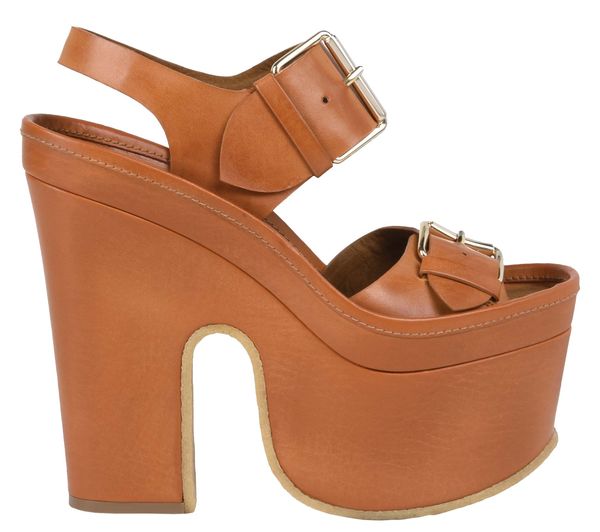 Stella McCartney’s Resort 2017 platform is made with a leather substitute using renewable vegetable oil and recycled polyester.Courtesy: Kering
What are your conversations like with Stella McCartney, known for not using leather?
Stella is always one step further than anyone. I follow her! We have internally what we call the “new business model.” Stella is very much involved in the thinking of what that should be. For instance, [to reduce landfill waste,] we did a partnership with H&M and this company called Worn Again. [They’ve developed a recycling technique that separates blends back into original fibers and removes chemicals so the fiber can be rewoven.] This was brought by Stella.We also are working very significantly on new technology coming from biotech—trying to create leather from living animal cells. They get the animal cells from the skin of a living animal, and then they grow them. They’re going to do transparent leather. Not before 10 or 15 years. One of the students that won the award from Kering [at the London College of Fashion] was based on mushroom leather. Those big mushrooms that grow around trees, beautiful things—it’s a parasite, by the way.
Are you finding that the rest of the fashion industry is paying attention to this now?
I do consider that the luxury segment of that industry is leading the race in sustainability, because we have the resources.But again, what is very complicated in the fashion industry as a whole is that it’s not integrated. It’s a value chain with many, many players. And what is striking, and this is the first learning from our EP&L when we released it for the first time, 93 percent of our footprint is outside our legal boundaries.
Presumably, if more people use your methods, it’ll make it more cost-effective, right?
As usual, you find things and people come to you and say, “Well, we know how to do that in a more sustainable way, but it costs more.” What do we do? Of course it’s more, because it’s not the way we were doing things before. But there’s no reason why it has to be. So, the example of metal-free tanning process, it’s 20 to 25 percent more expensive because we have to salt the skins at the beginning of the process, and only a certain number can go through that. Those that can’t are considered waste.And this is where I told the team we are not an NGO specializing in sustainability. We are a corporation, and through our creativity we have to find economically viable solutions. So we are trying to find ways of reselling those skins to other industries that could use that quality. We’re down to 10 to 12 percent more expensive now. We also need to scale to lower the cost. But we will reach that point.
What do you think about U.S. President-elect Donald Trump’s possible opposition to the Paris climate pact?
Sustainability for me has nothing to do with politics. Politics can help, but it’s much above any political issue. If it’s part of the political debate, there’s something completely wrong. So I couldn’t imagine that America wouldn’t be part of the Paris agreement.It’s above the four years of any president in the world. A country like China is moving so fast. Could you imagine that America could be the slowest? America should lead the race in that, of course. It’s the new moon. In the ’60s, America was walking on the moon. It was the big thing. The new frontier is the sustainability frontier.
-
Australian ‘breakthrough’ in recycling textile and other waste
Researchers at Deakin University in the Australian state of Victoria have found a way to separate blends of cotton-polyester material, hailing this as ‘a major breakthrough’ for recycling textile and other waste.
-
Pressure mounts on retailers to reform throwaway clothing culture
Yale Environment 360: Americans dispose of about 12.8m tons of textiles annually. But a growing number of environmentalists and clothing retailers say it’s time to begin making new clothes out of old items on a large scale
Source: Pressure mounts on retailers to reform throwaway clothing culture
-
Sustainability Is Out, Responsible Innovation Is In | Right Brain, Left Brain | BoF
At the Copenhagen Fashion Summit, economic growth and social and environmental responsibility were not seen as opposing ideas, reports Imran Amed.
Source: Sustainability Is Out, Responsible Innovation Is In | Right Brain, Left Brain | BoF
-
The Collections no. 1 ‘Roof Bars in Central London’
In London, there is always something new to do or place to go. So I decided to keep lists on my phone, to have them handy when I’m looking for somewhere or something.. they are lists like ‘places to eat in Notting Hill’ or ‘Things I like to collect’… so here they are, from me to you. I haven’t always been to all of them, and it’s an ever-growing project, so please, share your collections or thoughts in the comments
- Aqua Kyoto / Aqua Spirit: http://aqua-london.com
- Sanctum Hotel: http://www.sanctumsoho.com/roof-terrace
- The Courthouse Hotel: http://www.courthouse-hotel.com/restaurantsandbars-en.html
- Vista at The Trafalgar: http://www.thetrafalgar.com/vista-homepage/
- Radio Rooftop Hotel: http://radiorooftop.com/?page_id=2
- Orrery Terrace, Marylebone: http://www.orrery-restaurant.co.uk/at/terrace-marylebone/
Bring on Spring!
-
Op-Ed | Sustainable or Superficial? | Opinion, Op Ed | BoF
Fashion’s failure to move beyond the most easily achievable — and easily marketable — sustainability issues puts it behind other sectors, argues Lucy Siegle.
Source: Op-Ed | Sustainable or Superficial? | Opinion, Op Ed | BoF